Pineapple Crop Guide: Overview
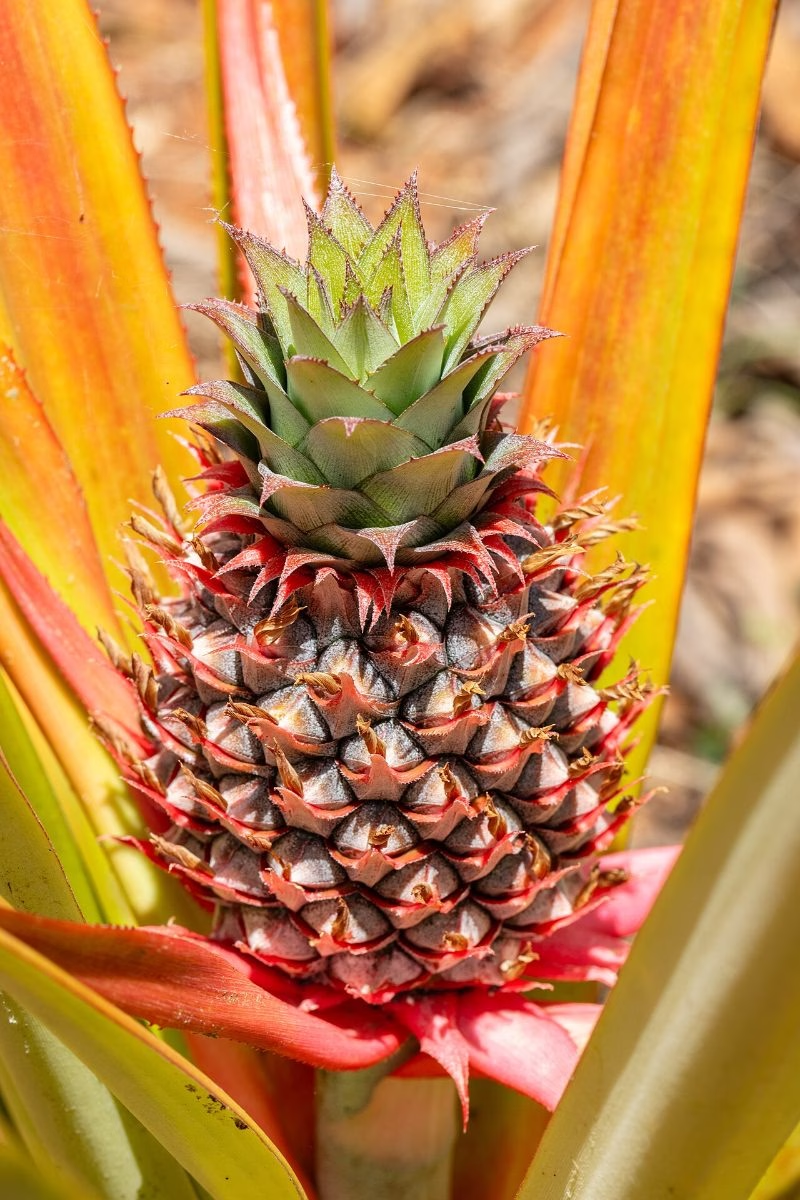
Pineapple is a perennial tropical fruit crop grown for fresh eating and processing. It prefers warm, humid conditions, well-drained acidic soils and raised beds, and in India it is grown mainly in the north-east, West Bengal and the southern states. Under intensive commercial management the page below quotes yields of 75 to 90 tonnes of fruit per hectare, though average farm yields are usually lower.
Overview
Pineapple (Ananas comosus, family Bromeliaceae) probably originated in South America. It is propagated from suckers, slips and crowns rather than seed. Assam, Tripura, Meghalaya, West Bengal and Kerala are among the leading growing states in India.
| Scientific name | Ananas comosus |
|---|---|
| Family | Bromeliaceae |
| Type | Perennial herbaceous fruit crop, usually one plant crop and one ratoon |
| Main regions in India | Assam, Tripura, Meghalaya, West Bengal, Kerala and others |
| Season | Planting time varies by region and planting material |
| Time to harvest | 1 to 2 years for the plant crop; 9 months to 1.5 years for the ratoon |
| Typical spacing | 0.6 x 0.3 m in double rows on beds 0.75 to 0.90 m apart |
| Typical yield | 75 to 90 t/ha under intensive commercial production |
Crop Description & Climate
- Pineapple (Ananas comosus) is a perennial crop grown for its fruits and used as a fresh and processed product.
- Pineapple is grown widely across the tropics, and global production runs to tens of millions of tonnes a year.
- The origin of the pineapple is still uncertain but the Parana-Paraguay Basin has been considered as a possible area.
- For good growth pineapple requires mean daily temperatures of 22 to 26°C with an optimum of 23 to 24°C.
- Mean daily maximum and minimum temperatures of 30 and 20°C respectively for the whole growing period are considered optimum.
- Temperatures below or above this range affect fruit quality or the acid and sugar content.
- The crop is grown between 31°N and 34°S, primarily in regions with high relative humidity.
- A combination of optimum temperature and high humidity results in soft, large leaves and juicy fruits, low in acid content.
- Fruits ripening in periods with cool temperatures and low radiation levels, e.g. in winter or at high altitudes, are of inferior quality because of poor shape for canning.
- Requirements for canning are: a cylindrical shape, fruit eyes of a relatively shallow surface and a small fruit core in relation to the fruit.
- Pineapple can grow on a wide range of soils but a sandy loam texture is preferred.
- Optimum soil pH is 4.5 to 6.5.
- The soil should have a low lime content.
- The crop is sensitive to waterlogging and therefore requires a well-drained soil with good aeration.
- For high production the fertilizer needs are 230 to 300 kg/ha N, 45 to 65 kg/ha P and 110 to 220 kg/ha K.
- Pineapple is usually grown in double rows on raised beds.
- With a spacing of 0.6 x 0.3m in beds 0.75 to 0.90m apart, plant population is about 50000 per ha.
- Shading is sometimes used where temperatures are high and radiation intense to protect the crop from scorching.
- The crop is multiplied using slips, crowns and shoots or suckers, but in comparison with using suckers as planting material, the period from planting to harvest is about 20 percent longer when slips are used, and about 35 percent longer when crowns are used.
- Use of different planting material allows a manipulation of the crop growing period and particularly in selection of the time of harvest when climatic conditions are favorable for high quality fruits.
- Normally the plant crop is followed by one ratoon crop, but when climatic conditions are favorable, the crop will continue to bear fruits but quality rapidly declines after the first ratoon.
- However, in warm tropical climates, e.g. at low altitudes near the equator, no ratoon crop is possible because suckers do not develop.
- The period from planting to harvest of the plant crop is 1 to 2 years and of the ratoon crop 9 months to 1.5 years depending on planting material and climate.
- The flower initiation in pineapple is induced by low temperature, water deficit or hormone spray; the latter results in a uniform fruiting and harvest period.
Plant crop, first ratoon and second ratoon (Collins, 1960)
|
Stages of |
Plant |
Region |
|||||
|---|---|---|---|---|---|---|---|
|
Crop |
Initial |
Crop |
Mid-season |
Late |
Total |
|
|
|
Stage length, |
60 |
120 |
600 |
30 |
790 |
February |
Hawaii, USA |
|
Depletion Coefficient, p: |
0.4 |
>> |
0.4 |
0.4 |
– |
||
|
Root Depth, m |
– |
– |
– |
0.5 |
– |
||
|
Crop Coefficient,Kc1: |
0.5 |
>> |
0.3 |
0.3 |
– |
|
|
|
Yield Response Factor, Ky |
– |
– |
– |
– |
– |
|
|
1 The pineapple plant has very low transpiration because it closes its stomates during the day and opens them during the night. Therefore, the majority of ETc from pineapple is evaporation from the soil. The Kc mid < Kc ini since Kc mid occurs during full ground cover so that soil evaporation is less. Values given assume that 50 % of the ground surface is covered by black plasic mulch and that irrigation is by sprinkler. For drip irrigation beneath rhe plastic mulch Kc’s given can be reduced by 0.10.
Water Requirements
- Crop water requirements (ETm) for high production are very different from those of most other crops.
- Because there is a suspension of transpiration during the day, maximum evapotranspiration is low and varies between 700 and 1000 mm per year
- The crop coefficient (kc) relating reference evapotranspiration (ETo) to ETm is about 0.4 to 0.5 for the total growing period.
Water Supply and Crop Yield
- When winter rainfall is insufficient to fill the full root zone to field capacity, irrigation should be applied before vegetative growth starts.
- Until the beginning of flowering, water should be applied when 35 to 45 percent of the total available soil water is depleted.
- Whether irrigation is necessary after flowering depends on the total available water over the root depth in relation to ETm.
- In shallow and light soils, irrigation will be necessary until harvest, but be applied at higher soil water depletion levels (soil water potential between 1 and 5 bars).
- In deep, fine textured soils irrigation should be discontinued in time to achieve the desired soil water depletion level toward harvest time.
- In warm, dry climates or when the fruits are harvested early, a light irrigation may, however, be required to prevent the soil from becoming too dry (water potential not exceeding 5 to 10 bars).
- When sprinkler irrigation is practised, irrigation should not take place during humid periods in order to assure rapid drying of the leaves (8 to 12 hours), and to reduce foliar burn and the hazard of fruit rot.
Water Uptake
- The rooting system of pineapple is shallow and sparse.
- In deep soils, maximum root depth may extend up to 1m but roots are generally concentrated in the first 0.3 to 0.6 m, from which normally 100 percent of the water is extracted (D = 0.3-0.6 m).
- Under conditions when maximum evapotranspiration is 5 to 6 mm/day, water uptake starts to be reduced when about 50 percent of the available soil water has been depleted (p = 0.5).
Irrigation Scheduling
- Adequate water supply is essential particularly during the vegetative period.
- The interval of application can be based on the prevailing rate of maximum evapotranspiration (ETm) and the fraction (p) of the total available soil water.
- Where rainfall is small and irrigation water supply is restricted, irrigation scheduling should be based on avoiding water deficits during the period of vegetative growth (1).
- Supply of water can be restricted during the period of ripening (4) whereas some water savings can be made by allowing higher depletion levels up to 75 percent during flowering (2).
- During the month prior to harvest irrigation is discontinued.
- The method of irrigation is mostly by sprinkler.
Yield
- The fruit contains about 80 to 85 percent water and 10 to 14 percent sugar.
- Irrigation has an effect on the sugar/acid ratio, particularly in the period prior to harvest when frequent high irrigation decreases the sugar content.
- Frequent heavy irrigation can also increase soil-borne fungal diseases.
- Under commercial production, weight per fruit is about 1. 5 to 1.8 kg, and total yield between 75 and 90 ton/ha fresh fruit.
- The water utilization efficiency for harvested yield (Ey) for fresh fruit is about 5 to 10 kg/m3for the plant crop and 8 to 12 kg/m3for the first ratoon crop.
Varieties
Kew (also called Giant Kew) and Queen are the main varieties grown in India, and Mauritius is also cultivated. Kew gives large, juicy fruits suited to canning and processing, while Queen has smaller, sweeter and more aromatic fruits that are popular for fresh eating. Choose the type recommended for your state and market by the state agriculture university or KVK.
Land Preparation
Plough the field two to three times to a fine tilth and remove weeds and old plant residues. Because the crop is sensitive to waterlogging, form raised beds and provide drainage channels, and mix well-decomposed FYM into the beds before planting. Soil should be acidic to slightly acidic, in line with the pH range given above.
Planting
Plant healthy, uniform suckers, slips or crowns in double rows at the spacing described above, firmly in the soil without covering the growing point. Suckers are preferred because they shorten the period to harvest compared with slips and crowns. Grading planting material by size helps give uniform flowering and harvest.
Weed Management
Pineapple roots are shallow, so avoid deep hoeing. Control weeds by shallow hand weeding, mulching, or black plastic mulch in beds, and keep the field clean in the early growth stages.
Pests and Diseases
Mealybugs, which are associated with mealybug wilt, scale insects and nematodes are the main pests. Heart rot, root rot and fruit rot are common in poorly drained soil. Use healthy planting material, good drainage and field sanitation, and remove infested plants. Check the state agriculture department or KVK before using any spray.
Harvesting
Fruits are usually ready about five to six months after flowering. They are harvested when the base of the fruit starts to turn yellow, with a short piece of stalk attached. Harvest fruits for distant markets slightly earlier than those for local sale.
Post-Harvest and Storage
Handle fruits gently to avoid bruising, keep them in shade, and sort by size and ripeness. Ripe pineapple is perishable, and it can suffer chilling injury if stored at very low temperatures, so grade, pack and move it to market or processing quickly.
Frequently Asked Questions
How long does pineapple take to fruit?
The plant crop takes about 1 to 2 years from planting to harvest, depending on planting material and climate. The ratoon crop takes 9 months to 1.5 years.
What spacing is used for pineapple?
Pineapple is usually grown in double rows on raised beds, at 0.6 x 0.3 m in beds 0.75 to 0.90 m apart. This gives a population of about 50,000 plants per hectare.
What soil and pH suit pineapple?
A well-drained sandy loam is preferred, with a pH of about 4.5 to 6.5 and low lime content. The crop does not tolerate waterlogging.
What is the yield of pineapple per hectare?
Under commercial production, fruit weighs about 1.5 to 1.8 kg and total yield is 75 to 90 tonnes per hectare. Average yields on many farms are lower than this.
Which planting material is best for pineapple?
Pineapple is multiplied by slips, crowns and suckers. Suckers shorten the time to harvest, while slips take about 20 percent longer and crowns about 35 percent longer.
How is flowering induced in pineapple?
Flower initiation is induced by low temperature, water deficit or a hormone spray, and the spray gives a more uniform fruiting and harvest period. Follow local recommendations for any growth regulator.
Monitoring Pineapple with Satellite Data
Satellite crop monitoring from MapMyCrop can help growers follow crop health in pineapple plantations, plan irrigation, track uneven growth and estimate yield. Explore the MapMyCrop products for field monitoring tools, and see our banana crop guide for another tropical fruit crop.